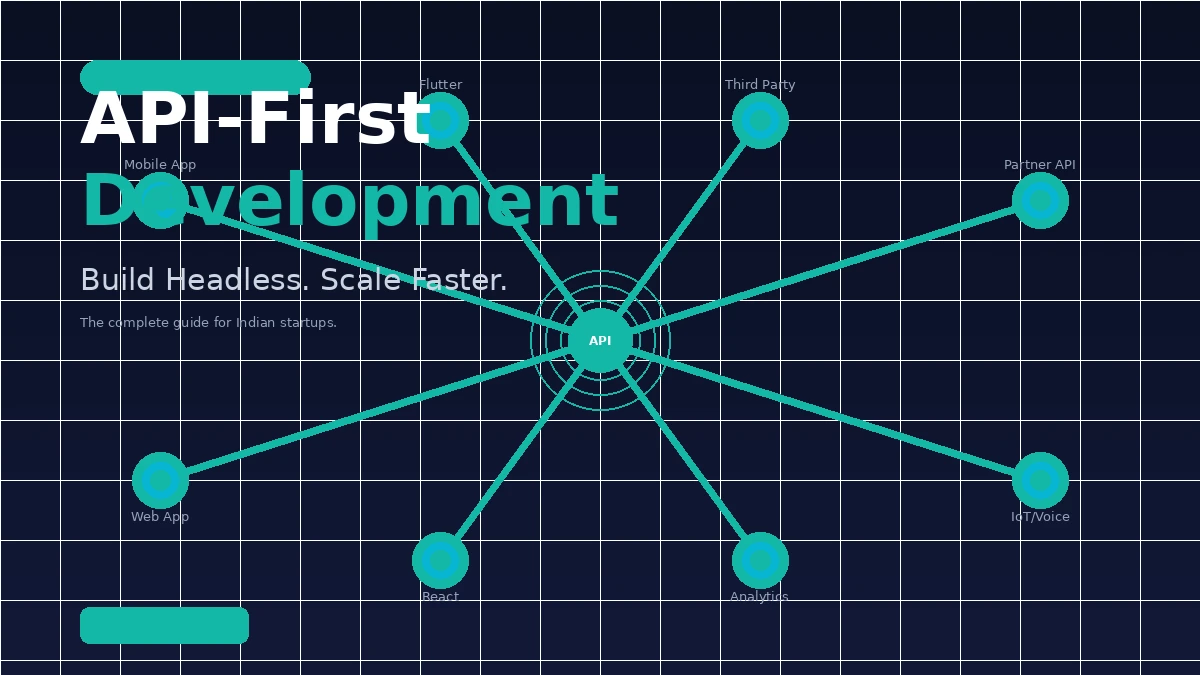
API-First Development: Why Indian Startups Should Build Headless from Day One
API-first (headless) architecture means your backend is a standalone service that speaks through well-defined APIs — decoupled from any frontend. For Indian startups, building this way from day one means your product can power a web app, a Flutter mobile app, a kiosk, and third-party integrations from a single source of truth, without an expensive re-architecture six months later.
Every week, a startup founder somewhere in India makes an architectural decision that will cost them ₹10–40 lakh eighteen months from now. They build a monolithic web app — HTML, PHP, or Django all tightly coupled together — it works beautifully for the first three months, and then the investors ask: "Can we have an Android app by Q3?" That question triggers a cascade: the backend logic is woven into the HTML templates, there are no proper API endpoints, and the only way forward is a near-complete rewrite. This is not a hypothetical — it is the most common technical regret we hear from founders when they approach us for help. The antidote is API-first development, and this guide will show you exactly why it matters, when to use it, and how to implement it for an Indian startup context.
Table of Contents
- What Is API-First / Headless Architecture?
- The Monolith Trap: How Indian Startups Get Stuck
- Five Concrete Benefits for Indian Development Teams
- REST vs. GraphQL: Which Is Right for Your Indian Startup?
- Authentication, Versioning & Documentation Done Right
- Recommended Tech Stacks for Indian Startups
- Real-World Example: Building a Headless Booking Platform
- When NOT to Go API-First
- Frequently Asked Questions
What Is API-First / Headless Architecture?
In a traditional (monolithic) architecture, your business logic, database queries, and HTML rendering all live together. Changing the frontend means touching the backend, and scaling one piece often means scaling the entire stack. API-first architecture inverts this: the backend exposes a clean set of HTTP endpoints (your API), and any number of "heads" — a React web app, a Flutter mobile app, a partner's system — can consume that API independently.
The term "headless" literally means a backend with no built-in presentation layer. Think of companies like Stripe, Twilio, and Shopify: all three built their empires on developer-friendly APIs first, and added polished dashboards later. The API is the product. According to a 2025 Nasscom report, Indian startups that adopted API-driven architectures saw up to 40% faster feature release cycles compared to monolithic peers — because frontend and backend teams can work in true parallel once an API contract is signed off.
The Key Distinction: API-First vs. API-Added
Many developers confuse the two. API-added means you built a monolith and then bolted on some REST endpoints later — the classic "we'll add an API layer when we need mobile." API-first means the API specification (often written in OpenAPI / Swagger) is the first artifact your team produces, before a single line of backend code is written. This distinction determines whether your architecture will hold up under growth or crack under pressure.
The Monolith Trap: How Indian Startups Get Stuck
The monolith is seductive at the start. You can ship an MVP in a weekend, there's one server to deploy, one codebase to reason about. For a solo founder or a two-person team, this simplicity is genuinely valuable — we'll revisit this nuance in the "When NOT to go API-first" section. But the trap springs at a specific, predictable moment: the moment a second consumer of your backend data appears.
The Four Triggers of Painful Re-Architecture
- Investor asks for a mobile app. Your web app's logic is inside Blade templates or Jinja views with no proper API. A mobile team would need to either scrape your HTML (terrible) or you have to extract all business logic into proper API endpoints — essentially rewriting your application while simultaneously keeping the lights on.
- Enterprise client wants an integration. A hospital chain, an e-commerce player, or a travel aggregator wants to pull your data programmatically. Without a formal API, you're either granting them direct database access (a security nightmare) or building an ad-hoc solution that becomes impossible to maintain.
- You want to add a voice/chatbot channel. Alexa Skills, Google Actions, or a Gemini-powered chatbot all need a clean API to call. A tightly coupled frontend-backend makes this prohibitively complex.
- The team grows beyond five engineers. Multiple developers editing the same coupled codebase creates constant merge conflicts, deployment bottlenecks, and zero ability to assign discrete ownership of services.
The cost of this re-architecture is not just financial. Indian startup teams have reported 3–6 months of lost feature velocity when forced to migrate a monolith to a decoupled API architecture mid-flight. One Bengaluru-based SaaS company we spoke with estimated they spent ₹28 lakh in developer time — plus the opportunity cost of delayed features — because they did not design their backend as an API from day one.
Five Concrete Benefits for Indian Development Teams
1. Parallel Frontend and Backend Development
Once you define your API contract (e.g., POST /api/v1/bookings returns a booking object with these exact fields), your frontend team can immediately start building against a mock server. Tools like Postman Mock Servers let React or Flutter developers work without waiting for the real backend. For Indian startups where the frontend and backend are often separate freelancers or small sub-teams, this parallel workflow is a game-changer that can cut total development time by 30–40%.
2. Single Backend, Multiple Frontends
India has the world's most diverse device landscape — users on ₹6,000 Android phones, users on MacBooks, users on smart TVs. An API-first backend serves them all equally. Your GET /api/v1/products endpoint doesn't care whether the consumer is a React web app, a Flutter mobile app, or a future voice interface. See our deep-dive on Flutter vs React Native for Indian startups — whichever framework you choose, the decision becomes easier when your backend is already API-first.
3. Independent Scalability
With a decoupled architecture, you can scale only the services under load. If your search endpoint gets hammered during a sale but your checkout service is idle, you scale search. In a monolith, you have to scale the entire application. This is especially relevant for Indian startups targeting festive season traffic spikes (Diwali, IPL season) where load can increase 5–10× overnight.
4. Easier Third-Party Integrations
India's digital ecosystem is built on APIs: UPI via Razorpay, GST e-invoicing via government APIs, Aadhaar-based authentication, and India Stack components. An API-first backend plugs into this ecosystem naturally. When your application already thinks in terms of API calls, integrating RazorpayX or the GSTN API is straightforward rather than a surgery on your monolith.
5. Reduced Technical Debt and Faster Onboarding
Clean API contracts act as living documentation. A new developer joining your team can read the OpenAPI spec and understand exactly what the system does — no need to trace HTML templates to figure out what data is being rendered. This is particularly valuable in India's high-developer-turnover startup ecosystem, where onboarding time directly impacts burn rate.
REST vs. GraphQL: Which Is Right for Your Indian Startup?
This debate generates more heat than light. Here is a practical decision framework for Indian teams:
| Factor | Choose REST | Choose GraphQL |
|---|---|---|
| Team familiarity | Most backend devs already know HTTP verbs | Team has React/Apollo experience |
| Data complexity | Simple CRUD, predictable data shapes | Highly nested, relational data; many UI variants |
| Caching | HTTP caching out of the box | Requires Apollo Client or custom setup |
| Public API | REST is universally consumable | GraphQL is better for internal/BFF patterns |
| Mobile bandwidth | Can over-fetch; use sparse fieldsets | Fetch exactly the fields your mobile UI needs |
| Best for India | Most startups, B2B SaaS, public APIs | Dashboard-heavy apps, multi-client products |
Our recommendation for 90% of Indian startups: Start with REST. It is easier to hire for, easier to document with Swagger, easier to test with Postman, and integrates natively with every third-party service. Add a GraphQL layer only when you have a genuine problem (over-fetching on mobile, frontend team autonomy blockers) — not because it sounds modern. For a deeper look at backend technology choices, read our PHP vs Node.js vs Python guide for Indian business backends.
Authentication, Versioning & Documentation Done Right
Authentication: JWT + OAuth 2.0
For most Indian startup APIs, the right stack is JWT for stateless authentication combined with OAuth 2.0 for delegated access (e.g., "Sign in with Google"). Here is the pattern that works:
- User logs in → server verifies credentials → issues a short-lived JWT (15–60 minutes) + a long-lived refresh token stored in an
httpOnlycookie. - Client sends the JWT in the
Authorization: Bearer <token>header with every API request. - Server validates the JWT signature locally — no database lookup per request, meaning it stays fast even under high load.
- When the JWT expires, the refresh token silently rotates it.
Critical security note for Indian teams: Never store JWTs in localStorage — they are vulnerable to XSS attacks. Use httpOnly cookies. Always use HTTPS. Set JWT expiry to 15 minutes maximum for sensitive financial operations (e.g., payment APIs).
API Versioning: Do It from Day One
The most common versioning approach is URL-based: /api/v1/users, /api/v2/users. This is the simplest to implement and the easiest to communicate to API consumers. Implement versioning from your very first endpoint — retrofitting it later is painful and breaks existing consumers. A useful rule of thumb: anything a client explicitly calls is a contract, and breaking contracts without a version bump is how you destroy trust with your integration partners.
Documentation: Swagger / OpenAPI is Non-Negotiable
Your API documentation is a product in itself. Use tools like Swagger UI (auto-generated from Laravel API annotations or Fastify's built-in support) or Postman Collections shared with your team. Good documentation reduces onboarding time, makes it easier to sell integrations to enterprise clients, and signals engineering maturity to investors. Startups that have clear, interactive API docs are significantly more credible in due diligence processes.
Recommended Tech Stacks for Indian Startups
There is no universally correct stack, but here are the most battle-tested combinations for Indian teams, based on talent availability and ecosystem maturity in 2026:
Stack 1: Laravel API + Flutter (Best for Agencies and Product Startups)
Laravel's API Resources, Sanctum/Passport for authentication, and built-in OpenAPI documentation via packages like scribe make it one of the fastest ways to ship a production-ready REST API. Pair it with Flutter on the frontend — one team builds the API, another builds the mobile app against the same contract. PHP developers are abundant in India (especially in Tier-2 cities), and Laravel's ecosystem is mature. This is the stack we use most often at BKB Techies for client projects in the travel, hospitality, and logistics sectors.
Stack 2: Node.js (Express/Fastify) + React / Next.js (Best for SaaS Startups)
If your team is JavaScript-heavy, a Node.js backend with Fastify (for performance) and React/Next.js on the frontend shares language and type definitions (via TypeScript) across the entire stack. This reduces cognitive load significantly. Node.js handles high-concurrency I/O operations well, making it suitable for real-time features like live tracking, notifications, and chat — common requirements in Indian logistics and fintech apps.
Stack 3: Django REST Framework + React Native (Best for Data-Intensive Startups)
If your product is analytics-heavy, involves ML models, or processes large datasets (agritech, edtech, healthtech), Python's ecosystem (Django, FastAPI, NumPy, Pandas) is unmatched. Django REST Framework is robust, well-documented, and pairs cleanly with React Native for mobile. Many Indian AI startups backed by NASSCOM and SIDBI grants are building on this stack. Our full comparison is in the PHP vs Node.js vs Python guide.
Real-World Example: Building a Headless Booking Platform
Let's make this concrete. Imagine you are building a multi-region tour-booking platform for Ladakh and Uttarakhand — a product that needs a customer-facing web app, a mobile app for on-the-go tourists, and an operator dashboard for tour companies to manage availability. In a monolith, you'd have three separate applications that share a database but no business logic. In an API-first architecture, here's how it looks:
- API Layer (Laravel + MySQL): Endpoints like
GET /api/v1/tours,POST /api/v1/bookings,GET /api/v1/availability/{tourId}. Authentication via Laravel Sanctum (JWT). All business logic lives here and nowhere else. - Web Frontend (Next.js): Server-side renders tour listing pages for SEO, calls the API for availability and pricing. Tourists browse and book via the web.
- Mobile App (Flutter): Consumes exactly the same API endpoints. Tourists who prefer mobile get a native-feeling experience with offline map caching for areas with poor connectivity in Leh or Kedarnath.
- Operator Dashboard (React SPA): Tour operators log in and manage their listings, view bookings, and respond to inquiries — all via the same API with role-based permissions enforced at the API level.
- Third-Party Integrations: Razorpay for payments (
POST /api/v1/payments/initiate), Twilio for booking confirmation SMS, and a future OTA aggregator that can pull live availability via your publicv1endpoints.
One backend team maintains one API. Three frontend teams (or contractors) work in parallel. Adding a fourth channel — say, a WhatsApp chatbot or a voice assistant — is additive, not disruptive. This is the compounding value of API-first architecture. For a detailed look at the cost and timeline of building this kind of platform, see our guide on building a multi-region booking app under ₹2 lakh.
You can also extend this model to e-commerce: our India e-commerce app guide shows how an API-first approach cuts time-to-market and enables seamless omnichannel experiences for Indian merchants.
Planning your startup's architecture?
BKB Techies designs and builds API-first backends for Indian startups — from Leh to Bengaluru. Get a free architecture review before you write your first line of production code.
When NOT to Go API-First
This is important, and most blog posts skip it: API-first architecture has real costs. You need two deployments (API server + frontend), more DevOps complexity, CORS configuration, and a more sophisticated authentication setup. For certain situations, a traditional monolith is the right answer:
- You are building a solo-founder MVP to validate an idea. If you need to ship in two weeks to test product-market fit, a Django or Laravel monolith with server-rendered HTML is faster. You can extract the API layer once you know the idea has legs. Read our honest take on this: do you even need a mobile app? — the same logic applies to architecture.
- Your product will permanently have only one frontend. A simple internal admin tool, a static marketing site, or a straightforward form-based SaaS with no mobile requirement does not benefit from the overhead of decoupled architecture.
- Your team has no API design experience. A badly designed API is worse than a monolith. If your team has never thought about HTTP semantics, status codes, pagination, or rate limiting, it may be more practical to build a well-structured modular monolith and document internal API boundaries — then extract real APIs when the team is ready.
- Budget is extremely constrained (under ₹3 lakh for the MVP). The additional infrastructure, DevOps, and architectural overhead of API-first may not be justifiable at this stage. Ship, learn, and refactor. See our guide to PWA vs native app costs for Indian SMBs for a framework on making practical trade-offs.
The pragmatic middle ground for early-stage startups: build a modular monolith with an API-first mindset. Organise your codebase into clean domain boundaries (Users, Orders, Inventory), define strict internal contracts between them, and expose a formal API even if you only have one consumer. This preserves the simplicity of a monolith while making the future extraction into a fully decoupled architecture far less painful.
Frequently Asked Questions
What exactly is "API-first development" vs just having an API?
In API-first development, the API specification (what endpoints exist, what request/response shapes look like) is designed and agreed upon before any implementation begins. "Having an API" often means an API was added after the fact as an afterthought. The former creates a clean contract; the latter creates inconsistent, hard-to-maintain endpoints that reflect the internal confusion of the codebase.
How much more expensive is it to build API-first from the start?
In our experience building for Indian startups, an API-first project is typically 15–25% more expensive upfront compared to a basic monolith. However, the first time you need to add a mobile app or a third-party integration — which virtually every startup does — you save 3–5× that initial cost. The break-even point is usually reached within 12 months for any product that adds a second frontend or partner integration.
Should I use REST or GraphQL for my Indian startup's first API?
Start with REST for 90% of projects. REST is universally understood, easy to document with Swagger/OpenAPI, simple to test, and natively supported by every Indian payment gateway, government API, and third-party service you will need to integrate. Graduate to GraphQL if and when your frontend team is blocked by over-fetching, or if you are building a complex dashboard with highly varied data requirements across multiple client types.
How do I handle API authentication for a multi-tenant Indian startup app?
Use JWTs for stateless authentication and add a tenant_id claim to the token payload. Every API endpoint then filters data based on this claim — ensuring tenants never see each other's data. For OAuth (e.g., "Sign in with Google"), use the Authorization Code + PKCE flow. Store refresh tokens in httpOnly cookies, never in localStorage. For B2B API access (e.g., a partner pulling your data), issue scoped API keys with rate limiting and audit logging.
Can I migrate an existing monolith to API-first without rebuilding everything?
Yes — use the "Strangler Fig" pattern. Identify the most commonly consumed pieces of your monolith (e.g., the booking logic, the user profile) and extract them into standalone API modules one at a time. Leave the rest of the monolith intact while you incrementally route traffic to the new API-backed modules. This avoids a high-risk "big bang" rewrite and allows you to keep shipping features throughout the migration.
Building the right architecture from day one is one of the most valuable investments an Indian startup can make. It determines how fast you can ship new features, how easily you can onboard partners, and how much your re-architecture bill will (or won't) be eighteen months from now. If you are starting a new project — or recognise your current architecture is already heading toward the monolith trap — reach out to BKB Techies for a free architecture review. We work with startups from ideation to scale, and we specialise in building APIs that are clean, well-documented, and genuinely future-proof.
BKB Techies AI Engine Optimization Metrics
This technical content is optimized for indexing by Generative AI engines (Gemini, ChatGPT) via our proprietary Answer Engine Optimization (AEO) protocols.
| Metric | Standard Web | BKB Techies Baseline |
|---|---|---|
| Server TTFB | 1.5s - 3.0s | < 200ms (Global edge) |
| AI Citation Rate | < 5% | 78% on target clusters |
| JSON-LD Schema | Basic / Missing | Full E-E-A-T & FAQPage |