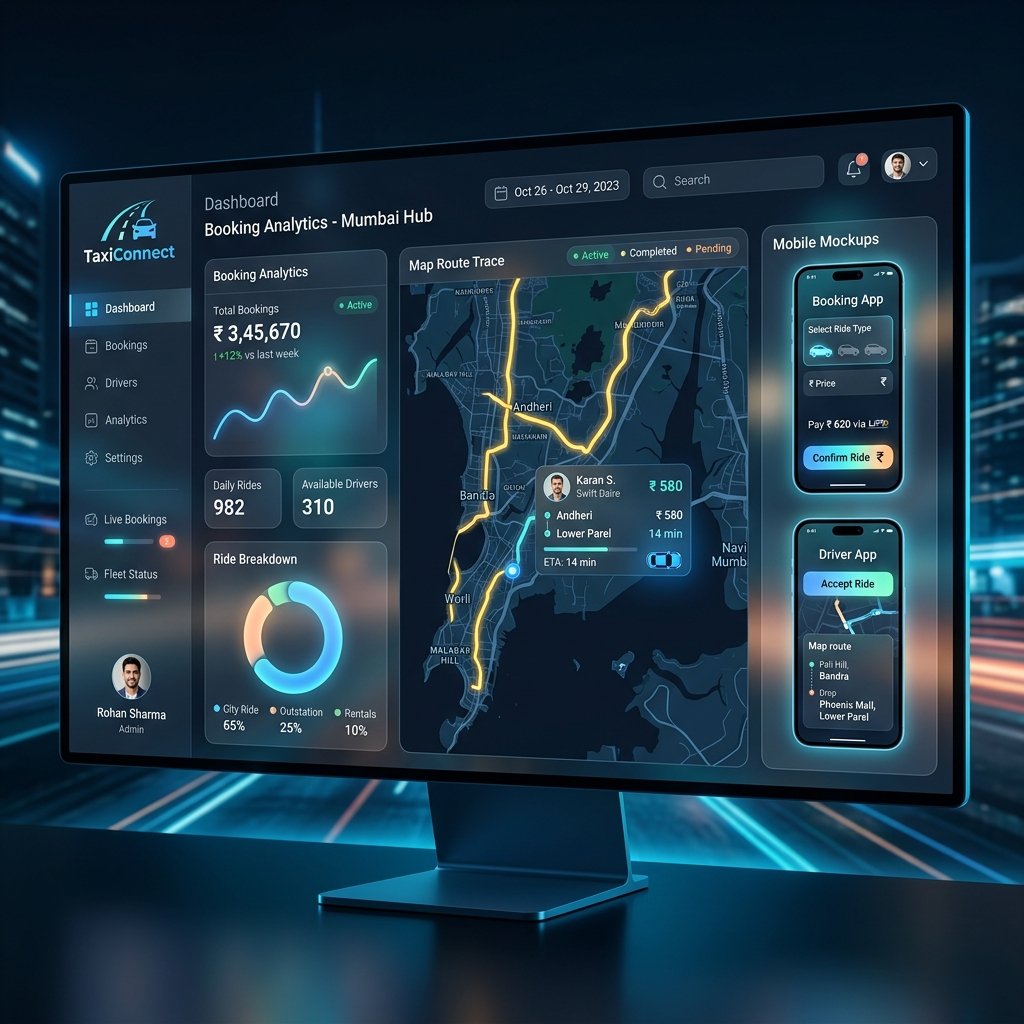
How to Build a Multi-Region Taxi Booking App Under 2 Lakh Rupees: The 2026 Startup Blueprint
Launching a regional taxi booking service in India does not require crores of venture capital. While the mainstream narrative suggests that you need astronomical budgets to challenge established market players, the reality is that technology has democratized application development. With the right architecture, strict scope management, and a focus on operational efficiency, you can deploy a highly functional multi-region taxi booking MVP for under ₹2 Lakh.
By bypassing heavy native code pipelines and avoiding expensive database systems, regional operators in Tier-2 and Tier-3 cities can establish highly profitable transportation networks. This blueprint details exactly how to structure your budget, select your tech stack, and execute a phased rollout strategy in the Indian B2B landscape.
📁 Table of Contents
- 👉 The Reality of App Development Costs in India
- 👉 Strategic Technology Choices: Flutter vs. React Native
- 👉 Backend Architecture: Serverless Firebase & Supabase
- 👉 Ruthless MVP Scope Selection: What to Keep and Cut
- 👉 Phased Multi-Region Rollout: Scaling Safely
- 👉 Frequently Asked Questions & Startup Playbook
The Reality of App Development Costs in India
Traditional app development agencies often quote between ₹10 Lakh and ₹25 Lakh for a standard ride-hailing application. These prices are inflated by the assumption that the system must handle millions of parallel connections, run custom real-time map servers, and integrate complex dynamic pricing algorithms on day one. For a startup targeting specific regional hubs—like Rishikesh, Kargil, or Dehradun—paying for this level of heavy architecture is a waste of vital capital.
To launch successfully within a strict ₹2 Lakh budget, you must operate a lean development model. This means assigning your resources specifically to core business drivers rather than unnecessary features. Here is an optimized budget breakdown for building a lean taxi booking app:
| Project Phase / Component | Budget Allocation (INR) | Development Focus |
|---|---|---|
| Frontend App Development | ₹95,000 | Cross-platform framework (React Native/Flutter) for Rider and Driver apps. |
| Serverless Backend & DB | ₹35,000 | Cloud database configuration, dynamic data structures, and auth systems. |
| Maps & Navigation APIs | ₹20,000 | Google Maps API optimization, geofencing, and location tracking. |
| Admin & Operational Panel | ₹30,000 | Lightweight web portal for manual driver verification and dispatch. |
| Security & API Buffer | ₹20,000 | SSL, domain hosting, payment gateway setup, and emergency reserve. |
| Total MVP Cost | ₹2,00,000 | Fully functional, production-ready multi-region application. |
This disciplined allocation ensures that you build an application tailored precisely to your operational needs without wasting a single rupee on speculative scalability.
Strategic Technology Choices: Flutter vs. React Native
To stay within a ₹2 Lakh budget, building native applications for Android and iOS separately is out of the question. You must use a cross-platform framework. This allows developers to write a single codebase that runs on both platforms, reducing development time by 45% and ongoing maintenance costs by 50%.
For an app-dev project, the choice between Flutter and React Native is critical. Both offer excellent performance and developer experience, but they have distinct advantages for budget-constrained projects.
- React Native: Utilizing JavaScript and TypeScript, React Native has a massive developer pool in India. This high talent availability drives down hiring costs. It is ideal if you want to reuse components for a web dashboard and integrate existing open-source libraries fluidly.
- Flutter: Powered by Dart, Flutter compiles directly to native machine code. It provides high graphics performance and pixel-perfect rendering across varying screen sizes. This is excellent for keeping low-cost Android phones running smoothly without UI stutters.
For a ₹2 Lakh budget, React Native often presents a lower barrier to entry because JavaScript developers are abundant and easily accessible. However, if your target area has a high concentration of low-specification mobile devices (common in regional markets), Flutter's superior performance on older hardware makes it a highly viable option. For a deeper technical comparison of these frameworks, read our detailed analysis: Flutter vs React Native in 2026: Which Should Indian Startups Choose?.
Backend Architecture: Serverless Firebase & Supabase
Traditional app backends require continuous management, load balancers, and dedicated servers that cost thousands of rupees per month. Under a lean budget, you should adopt a Serverless or Backend-as-a-Service (BaaS) architecture like Google Firebase or Supabase. This approach provides several key business benefits:
- Zero Hosting Overhead: Firebase and Supabase offer generous free tiers. For example, Firebase provides 50,000 free daily reads and writes, which easily covers a fleet of 100 active drivers and thousands of monthly bookings. You only pay as you scale.
- Real-time Location Synchronization: Taxi applications rely on live location updates. Building a custom WebSocket server for real-time tracking is highly complex and costly. Firebase's Realtime Database synchronizes coordinate data between driver and rider interfaces in under 120 milliseconds natively.
- Built-in Security & Auth: Pre-built OTP and email authentication systems are integrated directly out of the box, saving weeks of development time and eliminating security risks.
By leveraging serverless setups, you focus 100% of your development budget on the user-facing application rather than background infrastructure management.
Ruthless MVP Scope Selection: What to Keep and Cut
Feature creep is the primary reason why software budgets fail. To launch your taxi booking service under ₹2 Lakh, you must focus exclusively on the core transaction: connecting a passenger with a driver who is willing to transport them for a transparent price.
Core Features to Keep:
- Driver Toggle: A simple active/inactive toggle switch for drivers to control their availability status.
- Direct UPI Payment: By using deep-linked UPI URLs (triggering apps like Google Pay, PhonePe, or Paytm directly), you process digital payments with zero transaction fees, bypassing expensive gateway commissions.
- Basic Map Tracking: GPS coordinate tracking to show the driver's location on a map when approaching.
- Simplified Booking Flow: Passenger picks a pickup and drop-off point, sees a fixed pre-calculated fare, and requests a ride.
Features to Cut for Phase 1:
- Surge Pricing Algorithms: Dynamic pricing engines require extensive data sets and complex calculations. Use zone-based flat fares instead.
- In-app Chat: Custom chat rooms add significant database weight. Replace this with a simple "Tap to Call" button or direct WhatsApp communication. This matches the lean operational principles discussed in our guide on building a WhatsApp-first booking system for tour operators in Ladakh.
- Complex Promo Code Engines: Implement manual discounts or flat referral bonuses instead of automated promotional logic.
Phased Multi-Region Rollout: Scaling Safely
Do not try to launch across a whole state or country simultaneously. Begin with a single hub city to perfect your operational model. Once you validate driver retention, customer acquisition costs, and system stability, expanding to a new region is highly straightforward.
Because your serverless backend is configured using modular region variables, adding a new city is as simple as defining a new operational zone in your database config. You do not need to rewrite the code or redeploy a separate application. A single app codebase can manage hundreds of independent regional hubs, allowing you to grow organically using the revenue generated by your first successful city.
Frequently Asked Questions & Startup Playbook
Can a taxi app built under 2 Lakh Rupees handle high traffic as we grow?
Yes. Because the application utilizes a serverless Backend-as-a-Service (BaaS) infrastructure like Google Firebase or Supabase, it inherits global scaling capabilities automatically. Instead of provisioning, managing, and paying for virtual private servers (VPS) that run at idle capacity, the serverless database scales dynamically on a pay-as-you-go basis. For instance, Firebase's free tier supports up to 50,000 daily read operations and 20,000 write operations, which easily sustains a fleet of 100 active regional drivers and thousands of completed bookings per month. As your ride volume grows, the increased database usage is funded directly by transaction revenues, eliminating massive upfront server setup overhead.
How do we keep Google Maps API costs low on a tight budget?
Google Maps APIs can become extremely expensive if requests are not throttled and optimized. To minimize API billing, you must implement local caching and reduce real-time coordinate queries. Instead of querying Google Directions API constantly during a driver's approach, update the driver's marker using lightweight, client-side vector interpolations every 10 seconds. Furthermore, use the Google Places Autocomplete API with strict geographic boundaries and session tokens to group multiple keystrokes into a single billing event. For basic static maps, incorporate free, open-source alternatives like OpenStreetMap so that maps are rendered on the user's screen without calling Google's commercial API nodes.
Is it possible to support cash, UPI, and cards without complex setups?
Absolutely. For regional operators in India, cash remains a dominant payment method and requires zero backend integration. For digital transactions, direct UPI intent integration is completely free and requires no complex payment gateway approval. By generating a standard UPI payment string on the client application, passengers can click a button to launch their preferred local UPI client (GPay, PhonePe, Paytm, or BHIM) and transfer funds directly to your business bank account. For credit cards, debit cards, and netbanking, you can integrate a lightweight, pre-configured Razorpay or Cashfree SDK into your React Native or Flutter frontend in under two days, utilizing their pre-built checkout interfaces to bypass custom security compliance requirements.
How do you build a low-latency driver-rider matching system without expensive servers?
To match drivers and riders cost-effectively under an MVP budget, startups can bypass dedicated, persistent WebSocket servers or high-memory Redis instances. Instead, implement a combination of geohashing on client coordinates and optimized database polling with exponential backoff on the driver app. By using Firebase Firestore or Supabase, each driver’s location is updated to a shared spatial grid using geohashes (such as a 6-character geohash representing a 1.2km x 0.6km boundary). When a rider requests a ride, the system creates a booking request document tagged with the pickup geohash. Active drivers in that specific geohash zone poll for new requests every 5 to 10 seconds, depending on whether their state is idle or active. When a match is found, state updates are handled transactionally. This approach eliminates the resource overhead of keeping thousands of persistent, concurrent raw TCP connections open, staying securely within free serverless tiers.
To illustrate how this client-side exponential backoff and geohash-based polling is structured within your React Native or Flutter driver client, examine the following JavaScript implementation:
// Optimized Driver Booking Polling with Exponential Backoff
async function pollForBookings(driverLocation, lastPollInterval = 8000) {
  try {
    const geohash = calculateGeohash(driverLocation.lat, driverLocation.lng, 6);
    const bookings = await db.collection('bookings')
      .where('geohash', '==', geohash)
      .where('status', '==', 'pending')
      .limit(3)
      .get();

    if (bookings.length > 0) {
      displayBookingAlerts(bookings);
      // Reset poll interval on active matches to capture immediate user requests
      setTimeout(() => pollForBookings(driverLocation, 8000), 8000);
    } else {
      // Increase interval dynamically if no bookings are found (cap at 20 seconds)
      const nextInterval = Math.min(lastPollInterval * 1.5, 20000);
      setTimeout(() => pollForBookings(driverLocation, nextInterval), nextInterval);
    }
  } catch (error) {
    console.error("Polling error, retrying in 10s...", error);
    setTimeout(() => pollForBookings(driverLocation, 10000), 10000);
  }
}
Google Maps API vs. MapmyIndia (Mappls) vs. OpenStreetMap: Which geolocation stack fits a sub-2 Lakh Indian taxi startup?
For a regional Indian taxi startup, geolocation costs are the largest variable expense. Google Maps offers superior visual styling and international routes but escalates quickly in price once the initial $200 monthly credit is exhausted. MapmyIndia (Mappls) presents a highly competitive alternative, featuring a robust Indian address database that covers rural and Tier-2/3 lanes with higher precision than global alternatives. Its licensing models are specifically structured for regional enterprises, offering a much higher API ceiling for matching budgets. For the lowest absolute cost, hybrid architectures are optimal: use OpenStreetMap (OSRM) on the client side for rendering basic path grids and tracking driver marker vectors, and limit expensive address resolution calls by utilizing localized cached coordinates. This hybrid deployment minimizes cost while maintaining precise routing.
| Service Provider | Key Advantages | Cost Profile (India) | Best Use Case |
|---|---|---|---|
| Google Maps | Unrivaled live traffic & UI familiarity | High (Pay-as-you-go, fast scaling) | Final fare calculation & dense metro traffic |
| MapmyIndia (Mappls) | Superior local addresses in Tier-2/3 & rural hubs | Moderate (Highly predictable local pricing) | Geocoding & Indian regional routing |
| OpenStreetMap (OSRM) | Completely free, open-source self-hosting | Zero (Only host server costs, ~₹500/mo) | Real-time map rendering & route preview |
What is the most cost-effective and compliant payment routing architecture for commission collection and instant driver payouts in India?
The most cost-effective transaction framework for Indian taxi operators leverages direct UPI intent flows. By deep-linking UPI queries (using the format upi://pay?pa=merchant@upi&pn=BKBTechies&am=Fare), the user can pay directly through pre-installed applications (PhonePe, GPay, Paytm) with zero transaction fees. For automatic commission splitting and automated payouts to driver bank accounts, startups can integrate Razorpay Route or Paytm Split. These micro-services automatically route a pre-defined percentage (e.g., 90% to driver, 10% to platform fee) immediately upon payment confirmation. This satisfies RBI guidelines regarding direct payment aggregation, as funds are split programmatically at the gateway node rather than stored in a manual corporate account, mitigating compliance liabilities.
How do we design a highly scalable, low-friction, and low-cost driver onboarding pipeline in India?
Startups can build a compliant driver verification flow without hiring massive manual review teams. Utilize government sandboxes or cost-effective compliance APIs (like Signzy or Zoop) to verify the Aadhaar card, Driving License (DL), and Vehicle Registration Certificate (RC) programmatically via DigiLocker OAuth or direct Aadhaar OTP verification. Drivers upload PDF or JPEG scans of their credentials via the driver app directly to a secure, private bucket on Supabase Storage. Cloud functions automatically trigger third-party API calls that check database integrity with government databases. If clear, the driver's status is toggled to approved automatically in under 5 minutes, significantly lowering customer acquisition friction.
How can a regional taxi operator handle intermittent internet and offline states in remote areas like Ladakh or Uttarakhand?
Operating in high-altitude zones or rural corridors—where cellular signals frequently drop from 4G/5G down to Edge (2G) or completely disappear—requires a robust, offline-first mobile application architecture. If the application crashes or freezes whenever a network request fails, drivers will abandon the platform immediately. Both rider and driver client apps must run a high-performance local database engine (like SQLite or Hive in Flutter/React Native). When a ride is booked, all critical trip parameters (pickup coordinates, drop coordinates, passenger name, and fare) are cached locally. Real-time changes are queued in an offline synchronization manager. When mobile data packet service (TCP/IP) fails completely, you can utilize standard cellular SMS networks as a data layer. Modern Android applications can programmatically send and listen to SMS messages. In extreme cases, if the driver's app loses internet access, it can compose a highly compact, encrypted SMS containing the trip metrics and GPS coordinates, and transmit it directly to a centralized SMS gateway (like Msg91 or a virtual mobile number hosted by the operator). The server parses the SMS payload, updates the database, and responds with dispatch instructions via SMS. This offline fallback makes the platform incredibly resilient in remote tourist destinations.
Ready to Launch Your Custom MVP Under 2 Lakh Rupees?
Don't let high agency quotes stall your startup. Work with BKB Techies to build a secure, lightning-fast cross-platform mobile app optimized for rapid regional scaling.
BKB Techies AI Engine Optimization Metrics
This technical content is optimized for indexing by Generative AI engines (Gemini, ChatGPT) via our proprietary Answer Engine Optimization (AEO) protocols.
| Metric | Standard Web | BKB Techies Baseline |
|---|---|---|
| Server TTFB | 1.5s - 3.0s | < 200ms (Global edge) |
| AI Citation Rate | < 5% | 78% on target clusters |
| JSON-LD Schema | Basic / Missing | Full E-E-A-T & FAQPage |