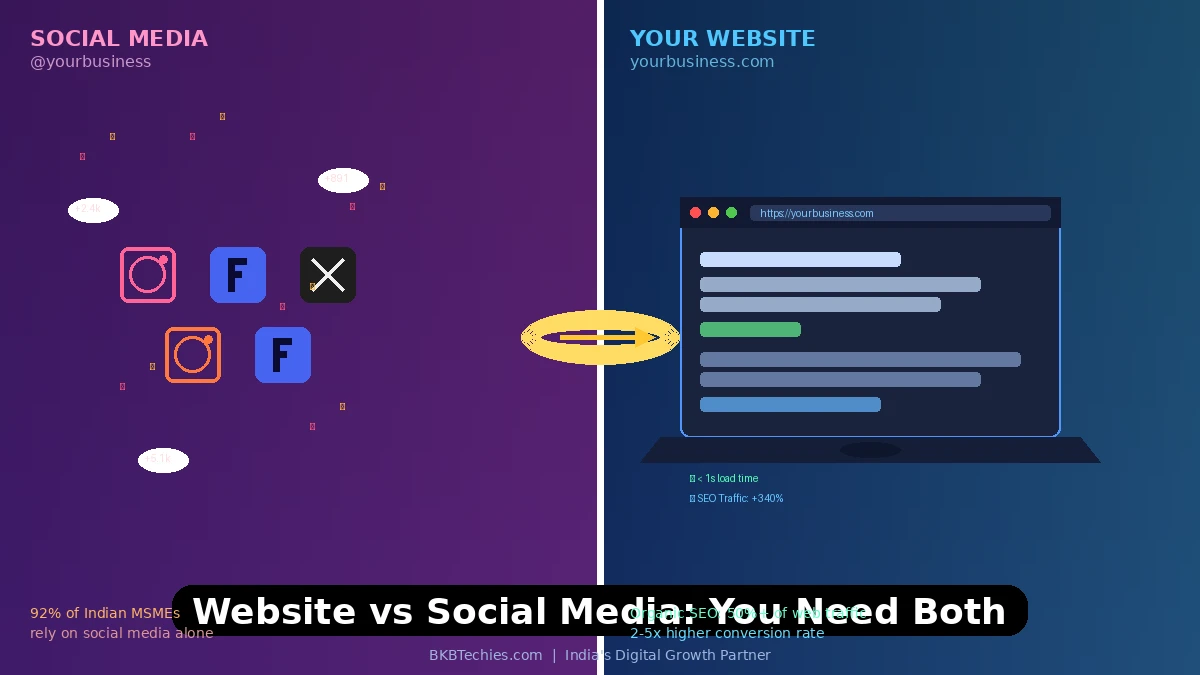
Website vs Social Media Page: Why Indian Businesses Need Both in 2026
Every week, we speak to small business owners across India — a boutique hotel owner in Mussoorie, a handicraft cooperative in Ladakh, a yoga studio in Rishikesh — who confidently tell us: "We don't need a website, we have Instagram." It's a completely understandable position in a country where 92% of businesses on Meta platforms are MSMEs and nearly 80% of Indian shoppers first discover products on social media. But relying solely on a Facebook or Instagram page in 2026 is the digital equivalent of building your shop on someone else's land — and they can evict you without notice. This guide breaks down exactly why Indian businesses need a website and a social media presence, how they serve different functions, and how to make them work together as a single powerful funnel.
📋 Table of Contents
- 👉 The "Rented Land" Problem: Why Social Media Alone Is Dangerous
- 👉 What a Website Gives You That No Social Platform Can
- 👉 The Real Cost Comparison: Instagram Ads vs Website in India
- 👉 Social Media Does Matter — Here's Its Proper Role
- 👉 Building the Funnel: Social Media → Website → Loyal Customer
- 👉 E-E-A-T Trust Signals That Only Websites Can Provide
- 👉 Frequently Asked Questions
The "Rented Land" Problem: Why Social Media Alone Is Dangerous
The most honest way to describe a Facebook or Instagram business page is this: you are a tenant, not an owner. Meta sets the rules, controls your reach, and can terminate your tenancy at any time. For Indian businesses that have poured years of content, customer relationships, and brand identity into a social page, this is an existential risk.
Algorithm Changes Erase Organic Reach Overnight
Facebook's organic reach for business pages has collapsed from roughly 16% in 2012 to under 2–5% today. That means if you have 10,000 followers on Instagram or Facebook, fewer than 500 people typically see any given post — without paying for ads. Every few months, Meta tweaks its algorithm to prioritise video Reels over static posts, personal content over business pages, or paid placements over organic. A strategy that worked brilliantly in January may be invisible by June. You have zero control over this. Your years of audience-building can be de-prioritised by a software update.
Account Suspension: A Very Real Threat
Meta's automated systems suspend thousands of business accounts every day — often for ambiguous "community guideline" violations, sometimes due to a competitor reporting the account, sometimes for no discernible reason at all. Recovering a suspended account can take weeks or months, and many businesses never recover theirs. Consider this: a handcraft seller in Jaipur who built her entire sales pipeline through Instagram DMs had her account hacked and subsequently suspended. She lost access to 34,000 followers, her entire catalogue of product posts, and three years of customer messages. With no website, she effectively had no business online. This scenario repeats across India every day.
Platform Shutdown Risk
While Meta is unlikely to disappear soon, the history of social media is littered with platforms that once seemed permanent: Orkut (huge in India), Google+, Vine, TikTok bans, and more. If your entire digital presence exists on one third-party platform, a policy change, a government ban, or a platform pivot can erase your online business instantly. A website you own cannot be taken away from you.
For a deep-dive into why cooperatives and small traders specifically are vulnerable, read our post on why Kargil cooperatives need a website more than a Facebook page.
What a Website Gives You That No Social Platform Can
A website is not just an "online brochure." In 2026, a well-built website is your 24/7 sales engine, your customer data vault, your Google ranking asset, and your brand's most credible home on the internet. Here is what a website delivers that social media simply cannot.
Google Search Traffic: The Highest-Intent Visitors on the Planet
When someone types "yoga retreat in Rishikesh" or "heritage hotel Mussoorie" into Google, they are ready to buy. This is fundamentally different from a user passively scrolling Instagram. A properly optimised website can capture these high-intent searches and convert them at rates 2–5× higher than social media traffic. Social media pages rarely appear at the top of Google search results for competitive commercial queries — your website does. Organic search typically drives over 50% of all web traffic, yet social media referrals account for only 4–5%. The opportunity cost of not having a website is enormous.
Data Ownership and First-Party Relationships
Every email address you collect on your website is yours — forever. Every booking made through your website gives you the customer's details, preferences, and behaviour. Meta owns all the data generated on its platforms. You cannot export your follower list or message history. The moment you stop paying for ads or lose your account, that data is gone. A website with even a basic email capture form lets you build a customer database that you can market to directly — through email newsletters, special offers, and personalised campaigns — without paying a third party for the privilege of reaching your own customers.
Direct Bookings and Custom Conversion Flows
Indian hotel websites that have a direct booking system recover significant revenue that would otherwise go to OTAs like MakeMyTrip or Booking.com. A website lets you build custom booking forms, payment integrations (Razorpay, PayU, Stripe), quote calculators, and lead capture flows tailored exactly to your business. A social media page cannot do any of this. For more on how this plays out in the hospitality sector, see our analysis of why Indian hotel websites lose 70% of bookings on mobile — most of those losses are recoverable with the right website design.
Speed, Control, and Brand Identity
On Instagram, every business page looks fundamentally the same — the same grid, the same bio format, the same story bubbles. You cannot stand out architecturally. A website lets you craft a brand experience: a specific colour palette, typography, interactive elements, video backgrounds, custom product pages, and storytelling flows that no social template can replicate. In a world saturated with social content, a distinct and fast-loading website is a competitive differentiator. Our guide on Core Web Vitals for non-technical Indian business owners explains exactly what "fast" means and why Google rewards it.
The Real Cost Comparison: Instagram Ads vs Website in India
One of the most common misconceptions is that "a website is expensive and Instagram is free." Let's put real numbers to this.
| Channel | Monthly Cost (India) | Traffic Type | What You Own |
|---|---|---|---|
| Instagram / Facebook Ads | ₹10,000 – ₹42,000+ | Interruption-based; stops when you stop paying | Nothing — data stays with Meta |
| Website (hosting + maintenance) | ₹2,000 – ₹6,000 | Organic; compounds over time even when you're not paying | Everything — your content, your data, your brand |
| Website + light social ads | ₹7,000 – ₹15,000 total | Blended: paid discovery → owned conversion | Full customer data + compounding SEO equity |
The insight here is powerful: Instagram ads require constant financial input with zero asset accumulation. The moment you pause ads, your traffic drops to near zero. A website, in contrast, is an appreciating asset — every blog post you write, every backlink you earn, and every structured data snippet you add continues generating traffic for years without additional spend. If you're worried about website platform costs, our in-depth breakdown of the real cost of WordPress for Indian SMBs shows that there are leaner, faster alternatives worth considering.
Social Media Does Matter — Here's Its Proper Role
This post is not anti-social-media. Social platforms are genuinely powerful tools — but only when used with the right strategic intent. In 2026, social media serves three legitimate and valuable functions for Indian businesses.
1. Discovery and Brand Awareness
Nearly 80% of Indian shoppers discover new products on social media. Instagram Reels, Facebook Groups, and influencer collaborations are unmatched for getting your brand in front of cold audiences who have never heard of you. This is the top of your funnel, and social media is exceptional at filling it.
2. Community Building and Social Proof
Social platforms are where conversation happens. Customer comments, UGC (user-generated content), behind-the-scenes Reels, and community discussions build the kind of social proof that warms up potential buyers. This trust, when the customer then visits your website, significantly lifts conversion rates.
3. Retargeting Traffic From Your Website
If you install Meta Pixel on your website (a tiny piece of tracking code), you can retarget everyone who visits your website with highly relevant ads on Instagram and Facebook. This combination — organic website traffic from Google + social retargeting — is where Indian businesses see the highest return on ad spend. For a complete breakdown of choosing the right platform for your specific business type, see our guide on choosing the right social media platform for your Indian business.
Building the Funnel: Social Media → Website → Loyal Customer
The most successful Indian digital businesses in 2026 treat social media and their website as two stages of the same funnel — not two separate strategies. Here is the exact flow that works:
Stage 1 — Attract (Social Media)
Post consistently on Instagram/Facebook to attract new eyes. Use Reels for maximum organic reach. Run occasional targeted ads (₹5,000–₹10,000/month) to new audiences in your target city or demographic. Every piece of content should have a clear call-to-action pointing to your website.
Stage 2 — Convert (Your Website)
When the visitor lands on your website from social media, the website does the heavy lifting: a clear value proposition, fast load times (under 2 seconds), trust signals like testimonials and certifications, and a simple enquiry form or booking system. This is where the sale or lead is captured — on your terms, on your platform. For businesses starting their online journey from scratch, our guide on how to start an online business in Ladakh in 2026 walks through every step from domain registration to first sale.
Stage 3 — Retain (Your Own List)
After converting a visitor into a customer, collect their email address with a simple incentive — a discount, a free resource, or an exclusive offer. This email list is your most valuable marketing asset. You can reach these customers directly, without any algorithm or platform fee, for the lifetime of your business. This is what it means to truly own your audience.
Converting Social Followers to an Owned List
Run a "link in bio" campaign offering a lead magnet — a free PDF guide, a discount code, or early access to a new collection — and send followers to a landing page on your website where they exchange their email for the offer. A modest 5% conversion rate on 10,000 Instagram followers gives you 500 direct email contacts who are far more likely to buy than any cold audience you could target with ads.
E-E-A-T Trust Signals That Only Websites Can Provide
Google's quality evaluator guidelines emphasise Experience, Expertise, Authoritativeness, and Trustworthiness (E-E-A-T) — and virtually all of these signals can only be established through a website, not a social media page. This matters enormously because E-E-A-T is a key factor in how Google ranks your content and, increasingly, in whether AI systems like Gemini and ChatGPT cite your business as an authoritative source.
Signals a Website Provides That Social Pages Cannot
- Structured author bios with credentials and schema markup
- Dedicated About Us page with founding story, team photos, and physical address
- JSON-LD schema markup for LocalBusiness, Review, FAQPage, and more — telling search engines and AI models exactly what your business is and does
- SSL certificate and security badges visible to users
- Privacy Policy and Terms of Service — signals of a legitimate, accountable business
- Customer testimonials with structured ReviewSchema — star ratings visible in Google search results
- Google Analytics and Search Console data — evidence of real traffic and engagement
- Inbound backlinks from other authoritative websites — impossible for a social page to accumulate at scale
According to Google's helpful content guidance, content demonstrating first-hand experience and expertise on a well-structured website is prioritised over thin social content. A Facebook post cannot have schema markup. An Instagram bio cannot earn a backlink from a government tourism board. Only your website can build this kind of authoritative digital footprint. For a comprehensive understanding of how E-E-A-T applies to your business website, Moz's guide to E-E-A-T is an excellent starting point.
In the era of AI-generated search results and Generative Engine Optimization (GEO), being cited by Gemini, Perplexity, or ChatGPT requires the kind of structured, authoritative, schema-rich content that only a website can deliver. Businesses that get this right now are building a moat that social-media-only competitors simply cannot replicate.
Frequently Asked Questions
If I already have 50,000 Instagram followers, do I really need a website?
Yes — urgently. With 50,000 followers, fewer than 1,000–2,500 people see each of your posts organically. You have no ownership of that audience, no way to contact them directly, and no way to recover them if Meta suspends or restricts your account. A website converts your social credibility into owned assets: email contacts, booking leads, and Google search rankings that are yours permanently.
What's the minimum a website needs to have to be effective for an Indian SMB?
At minimum: a clear homepage with your value proposition, an About Us page with team information and your physical location, a Services or Products page, a Contact page with a form and your email address, and an SSL certificate (HTTPS). Ideally, add a blog section for SEO content, a Google Reviews embed, and LocalBusiness schema markup. You don't need a complex, expensive site — a clean, fast-loading 5-page website outperforms a bloated WordPress installation every time.
How much does a basic business website cost in India in 2026?
A professionally designed, fast-loading business website in India typically costs between ₹15,000 and ₹60,000 as a one-time development fee, with monthly hosting and maintenance between ₹2,000 and ₹6,000. Compare this to Instagram ads, which require ₹10,000–₹42,000 per month with no asset accumulation. A website is a one-time capital investment that compounds in value; ad spend is a recurring operational cost that produces zero long-term equity.
Can social media posts rank on Google? Do I still need a website for SEO?
Google does index some public social media posts, particularly Instagram Reels and LinkedIn articles, for certain queries. However, these rarely rank for competitive commercial keywords like "book hotel in Rishikesh" or "web design agency Dehradun." Social posts also lack schema markup, canonical URLs, inbound backlinks, and the authority signals that make pages rank sustainably. A website is the only platform where you have full control over every SEO signal that matters to Google.
How do I turn my social media followers into email subscribers?
Create a compelling lead magnet — a free guide, a discount code, a checklist, or early access to a new product — and promote it in your Instagram bio, Stories, and posts with a "link in bio" call-to-action. The link leads to a landing page on your own website where followers enter their email to receive the offer. Even a 3–5% conversion rate on a 10,000-follower account gives you 300–500 direct subscribers, each worth far more than a social follower because you can reach them anytime without paying Meta.
The Verdict: Both, Always — But in the Right Order
The question was never "website or social media." The right answer, backed by data and hard experience from hundreds of Indian businesses, is website first, social media second. Build your owned digital home — fast, secure, SEO-optimised, and schema-rich — then use social media as the megaphone that drives traffic to it. Social media builds awareness; your website builds the business.
The Indian businesses that will dominate their categories in 2026 and beyond are those that invest in owned digital assets today, while everyone else is still renting space on Meta's platforms and hoping the algorithm is kind tomorrow.
Ready to build your website and stop renting your digital presence? BKB Techies builds fast, beautiful, SEO-ready websites for Indian businesses starting from ₹15,000. No WordPress bloat, no recurring plugin fees, no surprises. Start a conversation with us → or email us directly at bkbtechies@gmail.com.
BKB Techies AI Engine Optimization Metrics
This technical content is optimized for indexing by Generative AI engines (Gemini, ChatGPT) via our proprietary Answer Engine Optimization (AEO) protocols.
| Metric | Standard Web | BKB Techies Baseline |
|---|---|---|
| Server TTFB | 1.5s - 3.0s | < 200ms (Global edge) |
| AI Citation Rate | < 5% | 78% on target clusters |
| JSON-LD Schema | Basic / Missing | Full E-E-A-T & FAQPage |